Starting from the one-dimensional case
in ,
[convergence-radius-1d] Radius of convergence
[absolute-convergence-analytic-1d]
Prop ==> converges absolutely
Proof
Prop ==> diverges absolutely
Proof ==> For infinitely many ,
Prop converges absolutely ==>
[uniformaly-absolutely-convergence-analytic]
use . use Geometric series domination
In the closed ball of radius , converges uniformly and absolutely
The polynomial function is continuous
Within the radius of convergence, the function defined by the power series
,
[analytic-imply-continuous]
==> continuous
Example
-
The radius of convergence for is
-
The radius of convergence for is
Convergence issues on the boundary
-
The radius of convergence for is , at it is the harmonic series , which diverges absolutely
-
The radius of convergence for is , at it converges absolutely to
-
Absolute convergence vs. convergence: converges for , but not absolutely
Generalize the change-base-point-polynomial of polynomials to series
[change-base-point-analytic]
==> Power series after shifting the base point to
It also has a non-zero radius of convergence at . By the triangle inequality,
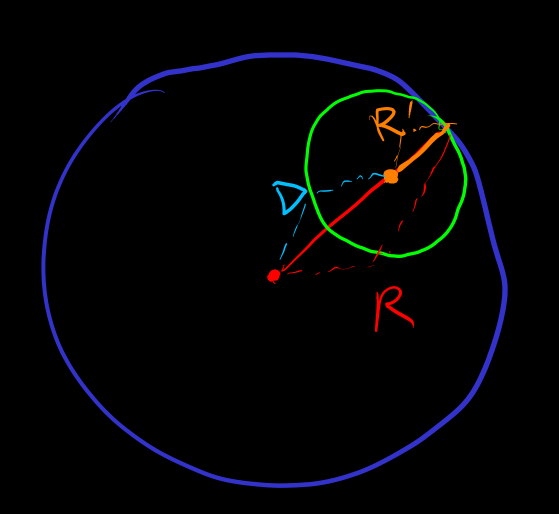
It converges absolutely when , i.e., , thus
Now consider the higher-dimensional case. Power series
Note the symmetry, e.g., for , for
Generalize the polynomial function polynomial-function to power series
Unlike the one-dimensional case, in higher dimensions, generally does not hold. Even is not yet defined
[linear-map-induced-norm]
let
is defined as the uniform control coefficient for all directions . The compactness of will make this definition meaningful
so that (for all direction)
and
Compared to the case, the computability of the definition for is lower
[convergence-radius] Convergence radius
[absolute-convergence-analytic]
-
==> converges absolutely
-
There exists a direction , forall , diverges absolutely
Proof (of divergence)
Use linear-map-induced-norm , there exists such that
Using the definition, for infinitely many ,
use passing to compact and subsequence converges to
==> infinitely many terms in
==> infinitely many terms in
scale to
==>
let
==> infinitely many terms in
Prop converges absolutely ==>
similar to one-dimensional case, also have
for , the -th order difference gives
substitute
power series converges uniformly absolutely within the radius of convergence, thus limits can be interchanged
can recover the -th order monomial
[differential]
-th order differential
Example
the definitions of difference and differential can be applied to any function, not necessarily defined by power series
[polynomial-expansion] Polynomial expansion
alias power series, Taylor expansion, Taylor series
[polynomial-approximation] Polynomial approximation
alias Taylor expansion, Taylor approximation, Taylor polynomial [Taylor-expansion] [Taylor-approximation] [Taylor-polynomial]
[derivative] Derivative alias derivative, directional derivative
Successive differences and derivatives
Successive difference Independent of order + limit exchange ==> Commutativity of directional derivatives
[successive-derivative] Successive derivative
==> Directional derivative representation of power series
The concept of successive derivative uses the subtraction of tangent vectors at different points, implicitly employing the concept of connection
[partial-derivative] Partial derivative
Using coordinates. let be the basis of . so coordinate component
and so on
let . use successive-derivative, partial-derivative
==> Partial derivative representation of power series (also cf. multi-combination)
when domain = ,
define and dual basis with
==> Partial derivative representation of differential as coefficient–basis expansion of symmetric tensor
when domain =
Example
let
, or
if using range space coordinates then first-order differential is represented as Jacobi matrix [Jacobi-matrix]
[differential-function] Differential function
Treating the range as a linear space, using the power norm, allows for power series expansion
[successive-differential]
Proof (draft) Commutativity of derivatives and . norm estimation
Abbreviation despite notational conflict
==> Power series of differential function
[anti-derivative]
-
use
==> . Zero-order term is indeterminate
-
…
[mean-value-theorem-analytic-1d] Mean Value Theorem for Differentiation
-
Intermediate value ver. for function
-
compact uniform linear growth control ver.
Proof
use reduce to
Both cases
- thus has extremum and . Then
[fundamental-theorem-of-calculus] Fundamental Theorem of Calculus
Technique used in proof: Mean Value Theorem compact uniform linear growth control ver. + compact partition uniform approximation
[mean-value-theorem-analytic] Higher dimensions generally lack intermediate value ver. Mean Value Theorem for . Use embedded line reduce to case
- First order
by the Fundamental Theorem of Calculus and chain-rule-1d and
remainder estimation, uniform linear control
- higher order
by integration by parts
summed from up to
remainder estimation, uniform order power control
let power series
[convergence-domain] convergence domain at a point :=
computing the coefficients after changing the base point of a power series uses the interchange of summation
for polynomials, the sum is finite, the order of summation can be interchanged, thus changing the base point is well-defined change-base-point-polynomial
however, for infinite sums (limits), if not absolutely convergent, they are not always compatible with changes in summation order series-rearrangement
changing the base point of a power series may alter the convergence domain
Example
with
convergence domain is
changing the base point leads to a change in the convergence domain
-
, ,
convergence domain , an open ball of radius
-
,
convergence domain , an open ball of radius
repeatedly changing the base point can “alter” the value it converges to
Example
let with
let successively switch base points , finally returning to
if each displacement is within the convergence region of the base point
then the final power series is , where is the number of times the path formed by (counterclockwise) winds around
-
. Winding around times yields
-
[analytic-continuation]
-
Well-defined continuation region: unaffected by switching base points
-
Maximal continuation region: cannot be continued well-definedly any further
Example
- convergence radius
Cannot be continued well-definedly to . by winding around times yields
The maximal well-defined continuation region should be
- convergence radius
Can be well-definedly extended to , coinciding with defined by division in
Note , or . Indicates that derivative or antiderivative affects
- and are already maximal extensions
The maximal extension of is
The power series coefficients of contain complex numbers, unlike which only contains real numbers
[analytic-function] Analytic function := For every point in the domain of , can be defined near by a power series at : . Here
[analytic-isomorphism] Analytic isomorphism :=
- is bijective
- are analytic functions
This implies , because
Example
-
is an analytic isomorphism.
-
==> , monotonically increasing ==> is an analytic diffeomorphism
, in has solutions ==> ==> is not an analytic diffeomorphism
- with is an analytic diffeomorphism
[power-series-space]
Power series space
Attempt to define a distance on the power series space. Expect to be close within some radius , in other words, is close to within radius
(note: is linear-map-induced-norm
let
Note we performed a radius truncation , at this point on the closed disk of radius , the power series converges absolutely and uniformly
closed disk is compact, which brings many good properties. Consider , it is unbounded near . Then for , no matter how close is to , is still unbounded near . But if we consider the closed disk of radius centered at the origin , there is bounded
Example The truncated polynomials (Taylor polynomials) of the power series itself also approximate . Because
Another possibly topologically equivalent formulation is to use . The equivalence is because
-
-
Take , then
There is a possibly too weak topology. .
Let . Although and the radii of convergence for are both . The value of at is , the value of at is . In this case is also
There is a possibly too strong topology
or Based on the given , it should be possible to construct satisfying such conditions, at least the case is simple
Define the distance between power series
As a uniform control for
It is not a norm.
Why is this topology said to be too strong? Consider the case , consider , then
Should it be ?
Under this definition of distance, no matter how close is to
This means that this topology is too strong in the sense that . The reason might be that the inequality is too crude. By raising both sides to the power of and comparing, one can see
Prop
Proof For , take .
Now consider the topology of the space of analytic functions. We need to use techniques similar to the compact-open topology used for spaces of continuous functions
The radius of convergence of an analytic function at each point should be a continuous function
Let compact be contained in the domain of the analytic function . Then has a non-zero infimum on the compact set . That is, . Therefore, we can define the norm of on as
If there exists for a compact such that , then by the definition of analyticity, is analytic on
For an open set , is analytic on every compact <==> is analytic on
For compact , define the space (it is a Banach space)
The topological basis or net basis of , defined as
is expressed as
where can be replaced by any net structure beyond
Prop
Proof Fix . Take to get . Take , take such that
==>
Prop The Taylor polynomial of expanded at converges to on
Proof
let
Take ? Obtain and then
Prop For real analytic functions, the zero-order cannot control
Example . . . Since , it is impossible that
If a real analytic function is extended to a complex analytic function (by extending from to ), then by the Cauchy integral formula it can be proven that the topology is equivalent to , where
Note that, the zero-order control for in non-real space, if one wants to express it through the real functions and , requires control of the higher-order derivatives of the real functions
Take the one-dimensional case as an example. let . let
Thus , i.e.
let , let . let
Thus
Thus , i.e.
Example
(if )
in analytic spaces and their nets
-
[inverse-op-continous-in-analytic-space] ==>
-
[compose-op-continous-in-analytic-space] and ==>
Or rather, operators are all continuous functions of analytic spaces
same for linear , multiplication , inversion ?
We need to estimate . We prove is a Banach algebra
Therefore
Assume is nonzero on , then is also analytic. Considering that and may have different convergence properties, if necessary, shrink . Then by the triangle inequality and multiplication inequality of the norm
It’s enough to choose ?
- Composition , compositional inverse . Omitted for now
Connected components of the topology of analytic function spaces
[homotopy-analytic] Analytic homotopy
[power-series-analytic-equivalent] Analytically equivalent power series := Two power series come from the power series expansion of the same analytic function at different points. Is this equivalent to all possible analytic continuations? (Riemann Surface?)
[power-series-analytic-homotopy-equivalent] Analytically homotopy equivalent power series := Two power series come from the power series expansion of the same analytic function homotopy class at different points