1. notice
  2. English
  3. logic-topic
  4. 1. logic
  5. 2. basic
  6. 3. map
  7. 4. order
  8. 5. combinatorics
  9. calculus
  10. 6. real-numbers
  11. 7. limit-sequence
  12. 8. division-algebra
  13. 9. Euclidean-space
  14. 10. Minkowski-space
  15. 11. polynomial
  16. 12. analytic-Euclidean
  17. 13. analytic-struct-operation
  18. 14. ordinary-differential-equation
  19. 15. volume
  20. 16. integral
  21. 17. divergence
  22. 18. limit-net
  23. 19. topology
  24. 20. compact
  25. 21. connected
  26. 22. topology-struct-operation
  27. 23. exponential
  28. 24. angle
  29. geometry
  30. 25. manifold
  31. 26. metric
  32. 27. metric-connection
  33. 28. geodesic-derivative
  34. 29. curvature-of-metric
  35. 30. Einstein-metric
  36. 31. constant-sectional-curvature
  37. 32. simple-symmetric-space
  38. 33. principal-bundle
  39. 34. group
  40. 35. stereographic-projection
  41. 36. Hopf-bundle
  42. field-theory
  43. 37. point-particle-non-relativity
  44. 38. point-particle-relativity
  45. 39. scalar-field
  46. 40. scalar-field-current
  47. 41. scalar-field-non-relativity
  48. 42. projective-lightcone
  49. 43. spacetime-momentum-spinor-representation
  50. 44. Lorentz-group
  51. 45. spinor-field
  52. 46. spinor-field-current
  53. 47. electromagnetic-field
  54. 48. Laplacian-of-tensor-field
  55. 49. Einstein-metric
  56. 50. interaction
  57. 51. harmonic-oscillator-quantization
  58. 52. spinor-field-misc
  59. 53. reference
  60. ไธญๆ–‡
  61. 54. notice
  62. ้€ป่พ‘
  63. 55. ้€ป่พ‘
  64. 56. ๅŸบ็ก€
  65. 57. ๆ˜ ๅฐ„
  66. 58. ๅบ
  67. 59. ็ป„ๅˆ
  68. ๅพฎ็งฏๅˆ†
  69. 60. ๅฎžๆ•ฐ
  70. 61. ๆ•ฐๅˆ—ๆž้™
  71. 62. ๅฏ้™คไปฃๆ•ฐ
  72. 63. Euclidean ็ฉบ้—ด
  73. 64. Minkowski ็ฉบ้—ด
  74. 65. ๅคš้กนๅผ
  75. 66. ่งฃๆž (Euclidean)
  76. 67. ่งฃๆž struct ็š„ๆ“ไฝœ
  77. 68. ๅธธๅพฎๅˆ†ๆ–น็จ‹
  78. 69. ไฝ“็งฏ
  79. 70. ็งฏๅˆ†
  80. 71. ๆ•ฃๅบฆ
  81. 72. ็ฝ‘ๆž้™
  82. 73. ๆ‹“ๆ‰‘
  83. 74. ็ดง่‡ด
  84. 75. ่ฟž้€š
  85. 76. ๆ‹“ๆ‰‘ struct ็š„ๆ“ไฝœ
  86. 77. ๆŒ‡ๆ•ฐๅ‡ฝๆ•ฐ
  87. 78. ่ง’ๅบฆ
  88. ๅ‡ ไฝ•
  89. 79. ๆตๅฝข
  90. 80. ๅบฆ่ง„
  91. 81. ๅบฆ่ง„็š„่”็ปœ
  92. 82. Levi-Civita ๅฏผๆ•ฐ
  93. 83. ๅบฆ่ง„็š„ๆ›ฒ็އ
  94. 84. Einstein ๅบฆ่ง„
  95. 85. ๅธธๆˆช้ขๆ›ฒ็އ
  96. 86. simple-symmetric-space
  97. 87. ไธปไธ›
  98. 88. ็พค
  99. 89. ็ƒๆžๆŠ•ๅฝฑ
  100. 90. Hopf ไธ›
  101. ๅœบ่ฎบ
  102. 91. ้ž็›ธๅฏน่ฎบ็‚น็ฒ’ๅญ
  103. 92. ็›ธๅฏน่ฎบ็‚น็ฒ’ๅญ
  104. 93. ็บฏ้‡ๅœบ
  105. 94. ็บฏ้‡ๅœบ็š„ๅฎˆๆ’ๆต
  106. 95. ้ž็›ธๅฏน่ฎบ็บฏ้‡ๅœบ
  107. 96. ๅ…‰้”ฅๅฐ„ๅฝฑ
  108. 97. ๆ—ถ็ฉบๅŠจ้‡็š„่‡ชๆ—‹่กจ็คบ
  109. 98. Lorentz ็พค
  110. 99. ๆ—‹้‡ๅœบ
  111. 100. ๆ—‹้‡ๅœบ็š„ๅฎˆๆ’ๆต
  112. 101. ็”ต็ฃๅœบ
  113. 102. ๅผ ้‡ๅœบ็š„ Laplacian
  114. 103. Einstein ๅบฆ่ง„
  115. 104. ็›ธไบ’ไฝœ็”จ
  116. 105. ่ฐๆŒฏๅญ้‡ๅญๅŒ–
  117. 106. ๆ—‹้‡ๅœบๆ‚้กน
  118. 107. ๅ‚่€ƒ

note-math

Binary relation := Propositional function or a subset of

when itโ€™s called is independent

-ary relation is similar

[order]

Propositional function is an order :=

  • Transitive:
  • Acyclic:

Can also use the โ€œequivalentโ€ version

  • Transitivity:
  • Reflexivity
  • Antisymmetry

Equivalence means

  • If we first have the version of partial order, then define , we get the version of partial order, and it can be converted back to (converting back is not obvious and requires the properties of partial order to prove, same below)
  • If we first have the version of partial order, then define , we get the version of partial order, and it can be converted back to

Prop partial order ==> irreflexive , i.e. a quantity canโ€™t be smaller than itself Proof If , then acyclicity is broken

Note: โ€œnonreflexiveโ€ is not not reflexive

Prop partial order ==> () Proof If then , this contradicts to nonreflexive of partial order

Def

Prop Assume is a partial order, then

Proof

But partial order satisfy , so

so

Prop Assume is a partial order, then Proof

But partial order satisfy

Proof <== is obvious. For ==>, assume . If then because , we have . If then

so

Prop (Proof does not require partial order properties of )

  • is reflexive
  • is irreflexive

Prop Acyclicity of ==> Antisymmetry of

Prop Antisymmetry of ==> Acyclicity of

Prop Transitivity of ==> Transitivity of

Prop Transitivity of + Antisymmetry ==> Transitivity of

These propositions together prove the equivalence of partial orders

Example

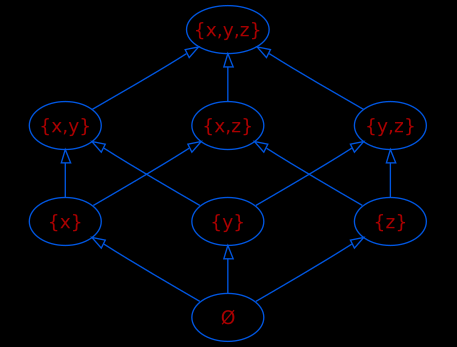
  • Subset โ€œinclusionโ€ or โ€œinclusion and not equal toโ€ is an order

    image modified from wiki media about partial order

  • of
  • Tree diagram

[order-comparable] comparable := (lt form) or (lte form) :=

[comparable-component] is comparable-component :=

Partial order can be decomposed into comparable-components that are not comparable to each other. Imagine two tree diagrams that have no relation

[linear-order] linear order

Intuitively, a linear order has no branches, also called a โ€œchainโ€

[maximal-linear-order] Maximal linear order chain

let with linear order. is maximal-linear-order := the following definitions are equivalent

It cannot be used to decompose partial orders. Two maximal linear order chains can have intersecting parts

Equivalently,

  • chain cannot be extended

The extension of chain means there exists and , such that for every , . After extension, is also a chain

[maximal-linear-order-exists] maximal-linear-order chain alaways exists

Also known as the Zorn Lemma

Requires Axiom of Choice: If it can be proven that some sets (of a certain type) have elements with a certain property, then a function can be defined that maps these sets to the corresponding elements.

Proof zorn_lemma.ac in my github repo ac-math ref-30