Binary relation := Propositional function or a subset of
when it's called is independent
-ary relation is similar
[order]
Propositional function is an order :=
- Transitive:
- Acyclic:
Can also use the "equivalent" version
- Transitivity:
- Reflexivity
- Antisymmetry
Equivalence means
- If we first have the version of partial order, then define , we get the version of partial order, and it can be converted back to (converting back is not obvious and requires the properties of partial order to prove, same below)
- If we first have the version of partial order, then define , we get the version of partial order, and it can be converted back to
Prop partial order ==> irreflexive Proof If , then acyclicity is broken
Note: "nonreflexive" is not not reflexive
Prop partial order ==> ( ) Proof If then
Def
Prop Assume is a partial order, then
Proof
But partial order ==> , so
Prop Assume is a partial order, then Proof
But partial order ==>
Proof <== is obvious. For ==>, assume . If then because , we have . If then
Prop (Proof does not require partial order properties of )
- is reflexive
- is irreflexive
Prop Acyclicity of ==> Antisymmetry of
Prop Antisymmetry of ==> Acyclicity of
Prop Transitivity of ==> Transitivity of
Prop Transitivity of + Antisymmetry ==> Transitivity of
These propositions together prove the equivalence of partial orders
Example
-
Subset "inclusion" or "inclusion and not equal to" is an order
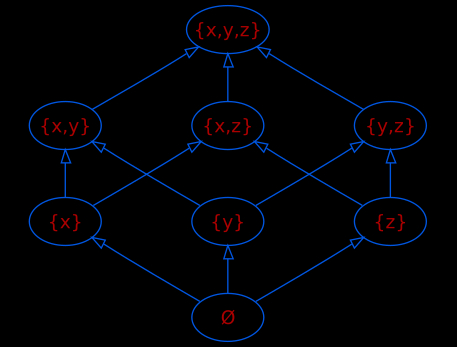
image modified from wiki media about partial order
- of
- Tree diagram
[order-comparable] comparable :=
[comparable-component] is comparable-component :=
Partial order can be decomposed into comparable-components that are not comparable to each other. Imagine two tree diagrams that have no relation
[linear-order] linear order
Intuitively, a linear order has no branches, also called a "chain"
[maximal-linear-order] Maximal linear order chain
let with linear order. is maximal-linear-order := the following definitions are equivalent
It cannot be used to decompose partial orders. Two maximal linear order chains can have intersecting parts
Equivalently,
- chain cannot be extended
The extension of chain means there exists and , such that for every , . After extension, is also a chain
[maximal-linear-order-exists] maximal-linear-order chain alaways exists
Also known as the Zorn Lemma
Requires Axiom of Choice: If it can be proven that some sets (of a certain type) have elements with a certain property, then a function can be defined that maps these sets to the corresponding elements.
Proof (ref-29) (ported from formal proof in zorn_lemma.ac in my github repo ac-math ref-30)
We can use the partial order of all intervals in as an intuitive example. An interval chain means that for every interval , either or
Assume there are no maximal chains, then every chain is extendable
According to the axiom of choice, an extension function can be constructed with domain and range , where is the extension element
Def The " " or "successor" of a chain is
Def Comparability between chains is defined as or
Def A set of comparable chains, or a linear set of chains .
Prop The union of elements of a linear chain set is a chain in , i.e.,
Proof
For each , there exist such that .
If , then are comparable
If , then are comparable
Def An inductive chain set and satisfies,
- Contains the zero element or inductive initial element.
- Contains "+1". For each , its successor also
-
The union of a linear chain set is also an inductive chain. If is a linear chain set , then
Seems similar to "strong induction" for : (for , is true ==> is true) ==> for all , is true
Prop Inductive chain sets exist. The set of all chains satisfies all properties required for
Def Minimal inductive chain set :=
Prop is an inductive chain set
Proof Prove that the properties of inductive chain sets are closed under intersection
- Zero element.
- +1
For each chain
For each
Thus
- Strong Induction
Let be a linear chain
For each
Thus
Def Comparable chains in the set of minimal inductive chains and satisfies
- For each , they are chain-comparable
Prop is a set of inductive chains
- Thus
- Thus
Proof
- Zero element
- . If is a comparable chain, then is also a comparable chain
Prop For , if , then
Proof is a comparable chain, so are comparable. . By contradiction, assume leads to a contradiction
Since is what we need to prove, we need to bypass it
Def Let be a comparable chain, is defined as and satisfies
- or
Prop is an inductive set
Proof
- Zero element
- "+1"
Let
- If , as stated before
- If , then and thus
- If , then
Thus or
Thus
- Strong induction
Let
For , take such that
or
==>
Thus
Back to proving the property of , proving
For
- If Then according to the definition of ,
Thus or
Thus
- Strong induction
Let and
For
- If for every , , then
- If there exists a such that , then
Thus are comparable, hence
Prop is a set of linear chains
Proof Using
- the properties of , and
Thus, the smallest inductive chain set is also a set of linear chains
Prop
Prop is a chain
Prop is a maximal chain
Proof
Define
Assume is not a maximal chain
By the properties of inductive chain sets,
, so
That is,
This contradicts , according to the definition of the chain extension function